
Lutetiae parisiorum, die XXI mensis aprilis, dominica III post Pascha
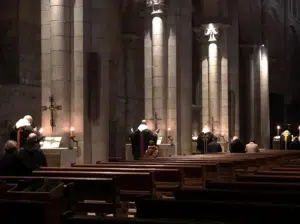
Being a Catholic in 2024 is no easy endeavor. The West is undergoing a massive de-Christianization, so much so that Catholicism appears to be vanishing from the public sphere. Elsewhere, the number of Christians being persecuted for their faith is on the rise. What’s more, the Church has been struck by an internal crisis that manifests itself in a decline in religious practice, a downswing in priestly and religious vocations, a decrease in sacramental practice, and even a growing dissension between priests, bishops and cardinals which, until very recently, was utterly unthinkable. Yet, among all the things that can contribute to the internal revival of the Church and to the renewal of her missionary zeal, there is, above all, the worthy and reverent celebration of her liturgy, which can be greatly fostered thanks to the example and the presence of the traditional Roman liturgy.
Despite all the attempts that have been made to suppress it, especially during the present pontificate, it lives on, continuing to spread and to sanctify the Christian people who are blessed to be able to benefit from it. It bears abundant fruits of piety, as well as an increase of vocations and of conversions. It attracts young people and is the fount of many flourishing works, especially in schools, and is accompanied by a solid catechesis. No one can deny that it is a vector for the preservation and transmission of the faith and religious practice in the midst of a waning of religious belief and a dwindling number of believers. This Mass, due to its venerable antiquity, can boast of having sanctified countless souls over the centuries. Among other vital forces still active in the Church, this form of liturgical life stands out because of the stability given to it by an uninterrupted lex orandi.
Certainly, some places of worship have been granted, or rather tolerated, where this liturgy can be celebrated, but too often what has been given by one hand is taken back by the other, without, however, ever managing to make it vanish.
Since the massive decline during the period immediately following the Second Vatican Council, every attempt has been made on numerous occasions to revive religious practice, to increase the number of priestly and religious vocations, and to preserve the faith of the Christian people. Everything, except letting the people experience the traditional liturgy, by giving the Tridentine liturgy a fair chance. Today, however, common sense urgently demands that all the vital forces in the Church be allowed to live and prosper, and in particular the one which enjoys a right dating back to over a millennium.
Let there be no mistake: the present appeal is not a petition to obtain a new tolerance as in 1984 and 1988, nor even a restoration of the status granted in 2007 by the motu proprio Summorum Pontificum, which, recognizing in principle a right, has in fact been reduced to a regime of meagerly granted permissions.
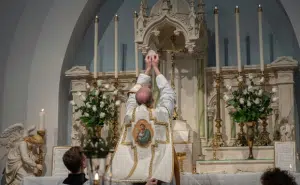
As lay people, it is not for us to pass judgment on the Second Vatican Council, its continuity or discontinuity with the previous teaching of the Church, the merits, or not, of the reforms that resulted from it, and so on. On the other hand, it is necessary to defend and transmit the means that Providence has employed to enable a growing number of Catholics to preserve the faith, to grow in it, or to discover it. The traditional liturgy plays an essential role in this process, thanks to its transcendence, its beauty, its timelessness and its doctrinal certainty.
For this reason, we simply ask, for the sake of the true freedom of the children of God in the Church, that the full freedom of the traditional liturgy, with the free use of all its liturgical books, be granted, so that, without hindrance, in the Latin rite, all the faithful may benefit from it and all clerics may celebrate it.
Jean-Pierre Maugendre, Managing Director of Renaissance Catholique, Paris, France
(Ce texte a été traduit et diffusé en allemand, anglais, espagnol, français, italien, néerlandais et portugais.)
This appeal is not a petition to be signed, but a message to be disseminated, possibly to be taken up again in any form that may seem appropriate, and to be brought and explained to the cardinals, bishops and prelates of the universal Church.
Si Renaissance catholique a l’initiative de cette campagne, c’est uniquement pour se faire l’interprète d’un large désir en ce sens qui se manifeste dans l’ensemble du monde catholique. Cette campagne n’est pas la sienne, mais celle de tous ceux qui y participeront, la relayeront, l’amplifieront, chacun à leur manière.
1 réponse
Paris, le 15 août 1982
OUR CONSTANT AND LEGITIMATE CLAIM
Since the publication in NOTITIAE n°185 of December 1981 of the “report on the investigation by Cardinal James KNOX, former Prefect of the Sacred Congregation for the Sacraments and Divine Worship, concerning the use of Latin and the Tridentine Mass”, the liturgical question rebounds. Is it not appropriate to briefly recall what Cardinals OTTAVIANI and BACCI thought in their “brief critical examination of the New Mass” presented to Paul VI on September 3, 1969?
The two prelates deplore in particular that “the new Ordo Missae, if one considers the new elements, susceptible of very diverse appreciations, insinuated or involved, which are appearing in it, stands impressively further away, on the whole as in the details, from the Catholic theology of the Holy Mass, as it was formulated at the XXIInd session of the Council of Trent”.
Quoting “a well-known periodical, intended for bishops and expressing their teaching”, Cardinals OTTAVIANI and BACCI believe that “one wants to make a clean sweep of all the theology of the Mass. Substantially, one is drawn nearer to the protestant theology which destroyed the sacrifice of the Mass”. Now, these criticisms perfectly determine the essential motive for our attachment to the ancient liturgy. It is therefore futile to evoke, in order to explain it, nostalgia or considerations of a political nature, if ever it would be true that they may be objectively established. In addition, we find, like our British friends, that “the old rite leaves more time than the new one to meditation during the Mass, that Latin has never been an obstacle to understanding…” and we also feel “the new rite as being less reverent, less conducive to meditation and, above all, to the respect due to the Blessed Sacrament…” (THE UNIVERSE of October 31, 1980). We therefore fully share their conclusions.
On the other hand, the Congregation gives us the feeling that “those who celebrate the Mass of Paul VI do not believe in the real presence of Christ in the Eucharist” (sic). This issue is extremely serious. It joins the main object of our motivation, the theology of the Holy Mass. “The ‘Last Supper’ is characterized as being that of the assembly presided over by the priest; that of the assembly gathered in order to realize “the memorial of the Lord” which recalls what He did on Holy Thursday”, write in the essential Cardinals OTTAVIANI and BACCI, continuing: “all this implicates neither the real Presence nor the reality of the Sacrifice, nor the sacramental character of the priest who consecrates, nor the intrinsic value of the Eucharistic Sacrifice independently of the presence of the assembly. In short, the new definition of the Mass (Institutio generalis, chapter 2, n°7) does not contain any of the dogmatic data which are essential to the Mass and which constitute its true definition. The omission, in such a place of this dogmatic data, can only be voluntary”. Now, our friends across the Channel consider “the English translation of the Mass ugly and inaccurate and doctrinally deficient…” Some even wish that “an English translation of the old rite be made available” (THE UNIVERSE, October 31, 1980). It is precisely the “inaccurate and doctrinally flawed translations”, the way they are felt and interpreted, the behaviours, that make us think that some “Catholics” do not or no longer believe in the real Presence in the Holy Eucharist. We are outraged that bishops, instead of observing the evidence, complain about people who only observe it. We are calling for a return to orthodoxy.
No, we are not indeed perpetual discontented neither nostalgic nor bitter nor politicized people who, bereft of serious motives, for only showing themselves inconsiderately to the fore, would keep on the liturgical quarrel. We love the Church we have chosen to belong to. We only keep in mind that “faith procures eternal life”.